
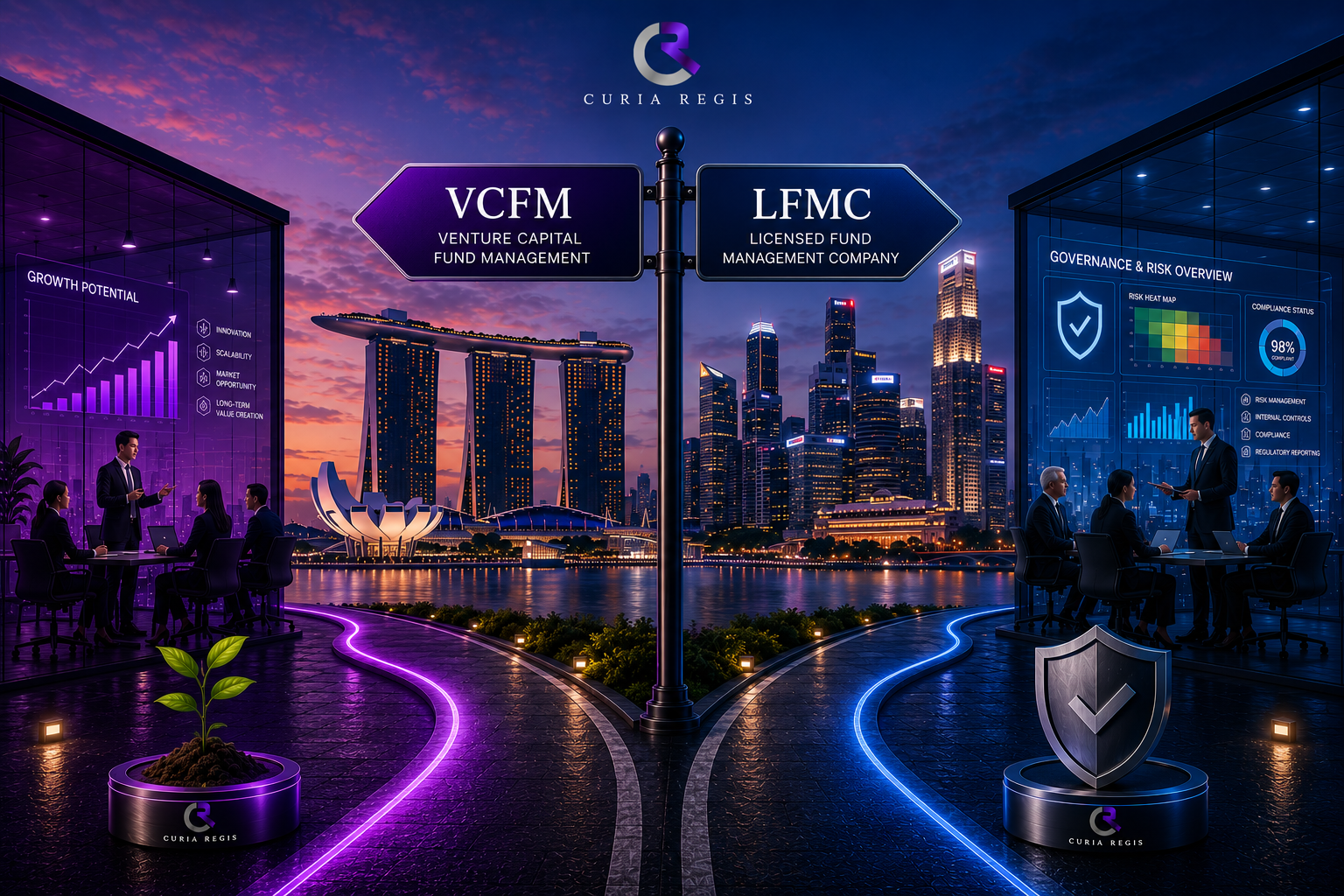
Following the removal of the Exempt Fund Manager (EFM) and Registered Fund Management Company (RFMC) licensing regimes, the Monetary Authority of Singapore (MAS) generally licenses fund managers seeking to establish operations in Singapore under either the Venture Capital Fund Manager (VCFM) regime or the Licensed Fund Management Company (LFMC) regime.
At the same time, the Assets under Management (AUM) and investor number caps applicable under earlier licensing regimes no longer apply to new licence applications. Instead, MAS places greater emphasis on the applicant’s business model, governance framework and management competency. MAS also assesses whether the applicant has sufficient financial resources and the ability to comply with ongoing regulatory obligations.
Although the VCFM and LFMC regimes are often discussed together, they occupy distinct positions within Singapore’s regulatory framework and serve different types of fund managers. Both the VCFM and LFMC regimes are licensing categories under the Capital Market Services Licence (CMSL) for Fund Management under the Securities and Futures Act 2001 (SFA). However, the VCFM regime provides a “light touch” licensing framework, whereas the LFMC regime supports fund managers pursuing a broader range of investment strategies.
The LFMC framework comprises two categories:
- Accredited/Institutional Licensed Fund Management Company (A/I LFMC); and
- Retail Licensed Fund Management Company (Retail LFMC).
Selecting the appropriate licensing category is a fundamental strategic decision. At Curia Regis, we work closely with prospective fund managers to assess which licensing framework best aligns with their proposed business model. However, prior experience and a proven track record are significant determinants in licence success rates. Misalignment between a firm’s business strategy, credibility, track record, and licensing category typically surfaces later as a costly relicensing exercise.
This article provides a comprehensive guide to Singapore Fund Manager Licensing, outlining the distinguishing characteristics of each licence category. The discussion is based primarily on the most recent version of the MAS Guidelines on Licensing and Conduct of Business for Fund Management Companies (SFA 04-G05)[1] and the FAQs on Licensing of Fund Management Companies.
Understanding Singapore Fund Manager Licensing begins with understanding the Venture Capital Fund Manager (VCFM) regime.
Singapore Fund Manager Licensing: Venture Capital Fund Management
The VCFM regime is a streamlined CMS licensing framework. MAS designed it specifically for managers of qualifying venture capital funds. MAS introduced the VCFM regime to reduce the admission burden for venture-focused managers. It recognised that the illiquid, non-retail nature of venture capital investing warrants a lighter regulatory approach than other fund management strategies, but to also introduce a some form of simple regulatory oversight moving away from unregulated club deals that use balance sheet funds for investing activities.
Application Process
Applicants submit Form 1 through MAS’s online licensing portal, together with supporting information relating to the applicant’s corporate structure, business model, key personnel, investment mandate, and source of capital, amongst others.
Timeline
While MAS does not prescribe a statutory processing timeline for VCFM licence applications, our experience indicates that MAS commonly processes complete and straightforward applications within approximately four months. However, the actual timeframe can vary significantly. This usually occurs where applicants do not clearly demonstrate how they satisfy the licensing criteria at the time of submission, or change their plans, personnel, structure and/or model midway through their application.
VCFM Eligibility Criteria
| Criterion | Requirement |
|---|---|
| Non-qualifying Investments | Capped at 20% of committed capital. Covers unlisted ventures already incorporated for more than 10 years at the time of initial investment, or stakes acquired through the secondary market. |
| Qualifying Investments | The remaining 80% of committed capital must be invested in securities issued directly by unlisted business ventures incorporated for 10 years or less at the time of initial investment.[2] |
| Fund Structure | Must be closed-ended; not continuously open for subscription, and not redeemable at the investor’s discretion. |
| Investor Eligibility | Accredited and Institutional Investors only. |
Minimum Staffing and Competency
| Role | Requirement |
|---|---|
| CEO | 1 employed full-time in the day-to-day operations of the company and resident in Singapore. |
| Directors | At least 2, of whom at least 1 must be an Executive Director employed full-time in the day-to-day operations of the company and resident in Singapore. |
| Professionals / Representatives | At least 2 full-time professionals and representatives resident in Singapore. Individuals may hold multiple appointments where appropriate (e.g. the CEO may also serve as an Executive Director, professional and representative). |
| Experience Threshold | No minimum requirement. MAS applies its fit-and-proper and competency assessment, taking a more flexible view of operating, entrepreneurial or sector-specific backgrounds. |
Key Regulatory Exemptions
Importantly, MAS also exempts VCFMs from Part III of the Securities and Futures (Financial and Margin Requirements for Holders of Capital Markets Services Licences) Regulations. As a result, VCFMs are not subject to a minimum base capital requirement. The regime also does not impose an AUM cap.
These regulatory concessions do not exempt VCFMs from MAS’ broader supervisory expectations. VCFMs remain subject to the applicable fit-and-proper criteria, comply with AML/CFT requirements, report misconduct, mitigate conflicts of interest, submit annual returns, and disclose to investors that they are not subject to the standard requirements imposed on LFMCs.
Advantages of the VCFM Licence
The principal advantages of the VCFM regime for eligible applicants include:
- No minimum base capital requirement.
- Typically shorter licensing review periods for straightforward applications.
- Minimum experience criteria not mandatory.
- Reduced ongoing compliance obligations.
However, the corresponding trade-off is reduced flexibility. Fund managers planning to expand beyond qualifying venture capital investments should carefully consider their licensing strategy. In these circumstances, an A/I LFMC may provide a more appropriate licensing framework.
The Licensed Fund Management Company (LFMC) regime represents the primary Singapore Fund Manager Licensing framework for managers pursuing broader investment strategies.
Singapore Fund Manager Licensing: The Licensed Fund Management Company
The LFMC is the standard full-scope CMS licensing category for fund management. It covers venture capital, private equity, hedge funds, private credit, real estate, external asset management, and other investment strategies. This is split into two sub-categories differentiated by permissible investor classes:
- Accredited/Institutional Licensed Fund Management Company (A/I LFMC)
- Retail Licensed Fund Management Company (Retail LFMC)
For companies requiring strategic flexibility beyond a pure venture capital mandate, this is the default licensing category.
The relevant experience criteria are mandatory. The following are finer details on what this entails:
- Amongst Senior Management, MAS generally expects at least one individual to possess relevant third-party portfolio management experience appropriate to the proposed investment strategy.
- The CEO must have some level of management experience.
- A relevant professional must have specific experience relevant to the role that they are designated with.
- Investment/product-related experience is a requisite, again, specific to the products and services offered by the applicant.
Financial and Margin Requirements
FMCs must maintain the following financial requirements on an ongoing basis:
- A/I LFMC: Minimum base capital of S$250,000.
- Retail LFMC: Higher minimum base capital requirements apply, depending on the nature of the regulated activities undertaken.
- Risk-Based Capital: Both A/I LFMCs and Retail LFMCs must maintain financial resources of at least 120% of their Total Risk Requirement (TRR) in accordance with MAS’ risk-based capital framework.
Compliance Obligations
Obligations increase proportionately with investor type and AUM.
- A Retail LFMC must maintain an independent compliance function in Singapore. It must be staffed by suitably qualified personnel who are independent of the front office.
- An A/I LFMC only needs an equivalent independent compliance function once its AUM reaches S$1 billion. Below that threshold, it may instead designate a senior officer independent of the front office or draw on support from its external compliance service provider.
Professional Indemnity Insurance (PII)
PII follows a similar split:
- MAS may impose a licence condition requiring a Retail LFMC to maintain Professional Indemnity Insurance (PII) on a tiered scale that starts at a minimum of S$2 million for AUM below S$100 million and rises to S$25 million for AUM of S$10 billion or more.
- MAS strongly encourages A/I LFMCs to maintain Professional Indemnity Insurance (PII), although it is not mandatory. A/I LFMCs must, however, disclose their PII arrangements, or the absence of such arrangements, to their customers.
Business Conduct Requirements
Additionally, LFMCs are subject to the following underlying business conduct requirements, including but not limited to:
- Independent custody of managed assets.
- Independent valuation and reporting.
- Documented conflicts of interest mitigation.
- Comprehensive risk management.
- Complaints handling procedures.
- AML/CFT compliance.
- Misconduct reporting.
- A recurring cycle of periodic regulatory returns and event-triggered MAS notifications and approvals.
Singapore Fund Manager Licensing Comparison
| Criterion | VCFM | A/I LFMC | Retail LFMC |
|---|---|---|---|
| Target investor base | Accredited and Institutional Investors only | Accredited and Institutional Investors only | All investors, including retail investors |
| Base capital requirement | Not applicable | S$250,000 | S$500,000 (non-CIS) or S$1,000,000 (retail CIS) |
| FRR/TRR Ratio requirement | Not applicable | ≥120% | ≥120% |
| CEO minimum experience | No prescribed minimum | 5 years | 10 years |
| Directors |
• At least 2 Directors
• At least 1 Executive Director
|
• At least 2 Directors, each with at least 5 years of relevant experience
• At least 1 Executive Director
|
• At least 2 Directors, each with at least 5 years of relevant experience
• At least 1 Executive Director
|
| Relevant professionals | Not separately prescribed | At least 2 relevant professionals | At least 3 relevant professionals |
| Representatives | At least 2 representatives (these representatives will not hold an RNF) | At least 2 representatives | At least 3 representatives |
| Compliance function | A designated senior officer or outsourced compliance support. | Independent compliance function required only when AUM reaches S$1 billion; otherwise, a designated senior officer or outsourced compliance support is sufficient. | Mandatory independent, dedicated compliance function in Singapore at all times. |
| Regulatory Reporting | Annual | Quarterly and annual | Quarterly and annual |
| External Audit | No specific MAS requirement | Annual | Annual |
| Professional Indemnity Insurance (PII) | Not required, but should be commensurate with the nature, scale and complexity of the business. | Strongly encouraged, but not mandatory. PII arrangements (or the absence thereof) should be disclosed to customers. | May be required as a licence condition. Where imposed, coverage is proportionate to AUM. |
| Internal Audit | Commensurate with the nature, scale and complexity of the business. | No prescribed frequency – general regulatory expectation: once every 2 years or upon material change of business. | No prescribed frequency – general regulatory expectation: once every 2 years or upon material change of business. |
General Licensing Considerations
Conflicts of Interest
Regardless of the licence category, MAS expects all Senior Management and Executive Directors to devote their full-time attention and commitment to the regulated entity. Holding external business interests may delay the application process. Applicants should therefore ensure that they identify and mitigate any potential conflicts before submitting the application.
Anchoring of Key Individuals
MAS also generally expects the CEO and Executive Directors to collectively hold a controlling stake in the applicant, also known as the “anchoring of key individuals” criteria. This reflects MAS’ expectation that those responsible for running the business on a day-to-day basis should also have a meaningful financial interest in its long-term success.
That said, there are permutations allowed. Applicants that form part of an established business group may propose alternative ownership arrangements. In such cases, the applicant will need to demonstrate to MAS that the proposed structure still ensures a stable management team whose interests remain aligned with those of its investors.
Post-License Issuance
It’s also worth noting that MAS’ quoted review period only covers the first stage of the application process. Once MAS has completed its review and is satisfied that the applicant has met the licensing criteria, it issues an In-Principle Approval (IPA) rather than the licence itself. Applicants then have up to six months to fulfil any outstanding conditions, such as meeting capital requirements or formalising key hires. MAS may extend this period by a further three months at its discretion before granting the licence.
Even after the licence is issued, the process does not end there. The licence will lapse if the company does not commence its fund management business within six months of its issuance. In other words, obtaining the licence is not the finish line; you also need to be fully operational within the required timeframe.
Exemption from Licensing
MAS only licenses companies that conduct substantive fund management activities in Singapore. This includes firms that provide portfolio management, investment research and trade execution services for third-party investors, unless a specific exemption applies.
Some of these exemptions are as follows:
- Non-Capital Market Product (CMP) Investments
Management of investments that fall outside the scope of the Securities and Futures Act (SFA), such as:
- Immovable assets (e.g. real estate, infrastructure and ships).
- Digital Payment Tokens (DPTs) and Digital Payment Token derivatives.
- Management of Proprietary Monies (No Third-Party Asset Management)
The fund management licensing regime exists for the provision of asset and fund management services to third-party investors. Where only proprietary assets are managed, applicants may instead rely on the Single-Family Office Exemption, subject to satisfying the applicable exemption criteria.
Choosing the appropriate Singapore Fund Manager Licensing regime requires careful planning. Consider your investor base, investment strategy and long-term business objectives.
Which Singapore Fund Management Licence is right for you?
Two primary determinants should guide your decision to obtain a Fund Management licence in Singapore:
- Investor classification (Retail vs Accredited and Institutional); and
- Investment mandate (venture capital only vs other investment strategies).
This tiering reflects a proportionality principle. Obligations scale with the degree of investor protection required, rather than applying uniformly across all fund management activities. Your primary consideration should be the trajectory of the intended mandate, not solely its current formulation.
The VCFM regime offers the most efficient route for managers pursuing a qualifying venture capital strategy. This applies where the fund invests only in qualifying unlisted companies, remains closed-ended, and is unlikely to expand beyond the venture capital mandate.
If there is a likelihood of adopting strategies such as public market investments, credit, private debt, private equity outside the qualifying venture capital definition, or investing more than 20% of committed capital in assets that fall outside the definition of “venture capital investments”, the A/I LFMC category may justify the additional capital commitment and longer processing period.
Conclusion
The Singapore Fund Management licensing regime caters to different business models, allowing applicants to choose a licensing framework that aligns with their investment strategy, investor profile and long-term growth plans.
- The VCFM regime is proportionate for companies with a defined venture capital mandate seeking an efficient route to market.
- The A/I LFMC category involves a longer processing timeline and higher capital commitment in exchange for greater strategic flexibility.
- The Retail LFMC regime is designed for companies that can meet the higher capital, staffing and governance requirements for serving retail investors. Applicants must also demonstrate the experience and track record expected by MAS for this licence category.
How Curia Regis Can Support
- Pre-licensing advisory services, including assessing whether the VCFM or LFMC regime is most appropriate for your proposed business model, investment strategy and long-term objectives.
- MAS licence applications, including preparing and reviewing application documents to ensure submissions are comprehensive, well supported and aligned with MAS’ regulatory expectations.
- Governance and compliance frameworks, including AML/CFT, Know Your Customer (KYC), Technology Risk Management (TRM), Business Continuity Management (BCM), regulatory reviews and reporting to support licensing and ongoing compliance.
- Ongoing regulatory advisory, assisting Fund Management Companies in meeting their continuing regulatory obligations and responding to evolving regulatory developments.
To discuss your Singapore fund management licensing requirements, contact Curia Regis or email admin@curiaregis.com.
[1] For a detailed analysis of the February 2024 amendments to SFA 04-G05 and their practical implications for fund management companies, readers may also refer to our related article, Update Feb 2024: Navigating Change – MAS Updates Guidelines on Licensing and Business Conduct for Fund Management Companies
[2] A follow-on investment in a company that initially qualified remains a qualifying investment, even if the company has been incorporated for more than 10 years when the follow-on investment is made. Similarly, a VCFM does not need to reclassify an original investment if a portfolio company’s shares are subsequently listed, provided the VCFM acquired the shares before the listing. In other words, the investment must satisfy the qualifying criteria when it is made.