
Singapore updated its National Risk Assessment (NRA) on Money Laundering (ML) and Terrorism Financing (TF) risks. The update reflects new threats and vulnerabilities shaped by global, regional and local developments. These include the ongoing Israel-Hamas conflict, a recent money laundering case, and the growth of cross-border digital financial services. The revised national strategy strengthens coordination across law enforcement agencies, policy makers, regulators and the private sector in Singapore.
Singapore’s National Risk Assessment: Five Principles to Counter ML and TF
- Coordinated and Comprehensive Risk Identification
- Strong Legal and Sanctions Frameworks
- Robust Regulatory Regimes
- Decisive Enforcement Actions
- International Partnerships and Cooperation

The revised NRA flags a key TF threat: rising fund flows to the Middle East from radicalised individuals and groups. These groups are sympathetic to terrorist causes. This threatens national security and Singapore’s reputation as an international business hub. The update focuses on how funds move and where they’re used. This covers Financial Institutions such as Banks, Money Remittance Companies, Online Fundraising Platforms and Digital Payment Token Service Providers.
At the same time, key ML threats mainly stem from:
- Fraud (cyber-enabled)
- Organised Crime (illegal online gambling) and
- Tax Crimes
Cyber-enabled fraud is a growing global problem. Social media platforms make it easier to reach mass audiences worldwide with little friction. This makes it harder for Singapore to curb misinformation and false ideologies spread through features like private direct messages.
Fraudulent proceeds are easily layered through complex networks. These networks comprise multiple layers of intermediary entities and/or transactions with shell companies using refined strategies, more so as compared to the past. Advanced cyber tools and anonymous transactions using cryptocurrencies are gaining traction in popularity. This makes it more challenging for authorities to track the source of funds and determine fund flows.
The following sectors carry a Higher ML Risk rating:
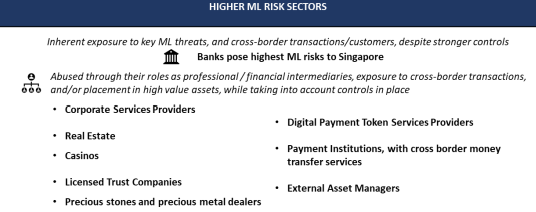
MONEY REMITTANCE COMPANIES
There are no changes to the risk rating for Money Remittance Companies as per the assessment above. Due to the significantly lower cost of using a Money Remittance Company compared to Banks, this contributes to the significant volume of transactions made. This renders higher exposure to ML and TF risks. As an international financial hub, Singapore faces voluminous money flows daily, which increases its vulnerability to potential exploitation. With new digital cross border payment services such as PromptPay and NETS-DuitNow, alongside the convenience, this also increases the chances of individuals supporting illegitimate activities overseas under the guise of other causes, e.g. online fundraising. Mules working for such syndicates are also able to make fund transfers easily to intermediaries or through the use of complex ownership/corporate structure to conceal their intended destination.
Money Remittance services are also preferred as a means to evade currency controls in their home jurisdictions and tax obligations for foreign workers in Singapore as it is less stringent compared to the Banks.
DIGITAL PAYMENT TOKEN SERVICE PROVIDERS
As of 2024, the risk rating for Digital Payment Token Service Providers changed from Medium-Low to Medium-High risk. In this digital era, virtual currencies are trending and heavily traded online. While there are multiple legitimate use cases for Digital Payment Tokens, it has also emerged as a potential avenue for tech-savvy militants and terrorist financiers to move their funds across borders seamlessly. It is less likely to be detected. The technology required to identify location and identities linked to such transactions may not be readily available yet. To illustrate, users are able to conduct ML/TF funding through such providers under the guise of sending gifts to content streamers on social media platforms. Since the platform charges consumers, these amount to legitimate transactions which render detection tough for suspicious activities.
What does this mean for you?
As a Regulated Financial Institution in Singapore, whether you are a fund management company, a broker-dealer, a cross border money transfer business or even a cryptocurrency exchange, your understanding and implementation of the National Risk Assessment’s determination of the higher risk-type industries and sectors within the financial industry is important. You would need to take into accord these new updates within your organisation, as part of your customer onboarding and ongoing due diligence measures, and as part of your Enterprise-Wide Risk Assessments.
If you are unsure as to how to implement the updated National Risk Assessment into your current framework, feel free to reach out to us at Curia Regis. Our team is able to offer comprehensive services to assist you in navigating the necessary requirements and documentation required, for you to satisfy your obligations as a Regulated Financial Institution in Singapore accordingly.
Contact us here at admin@curiaregis.com to know more and follow our LinkedIn page https://uk.linkedin.com/company/curiaregis for updates in the regulatory space.